
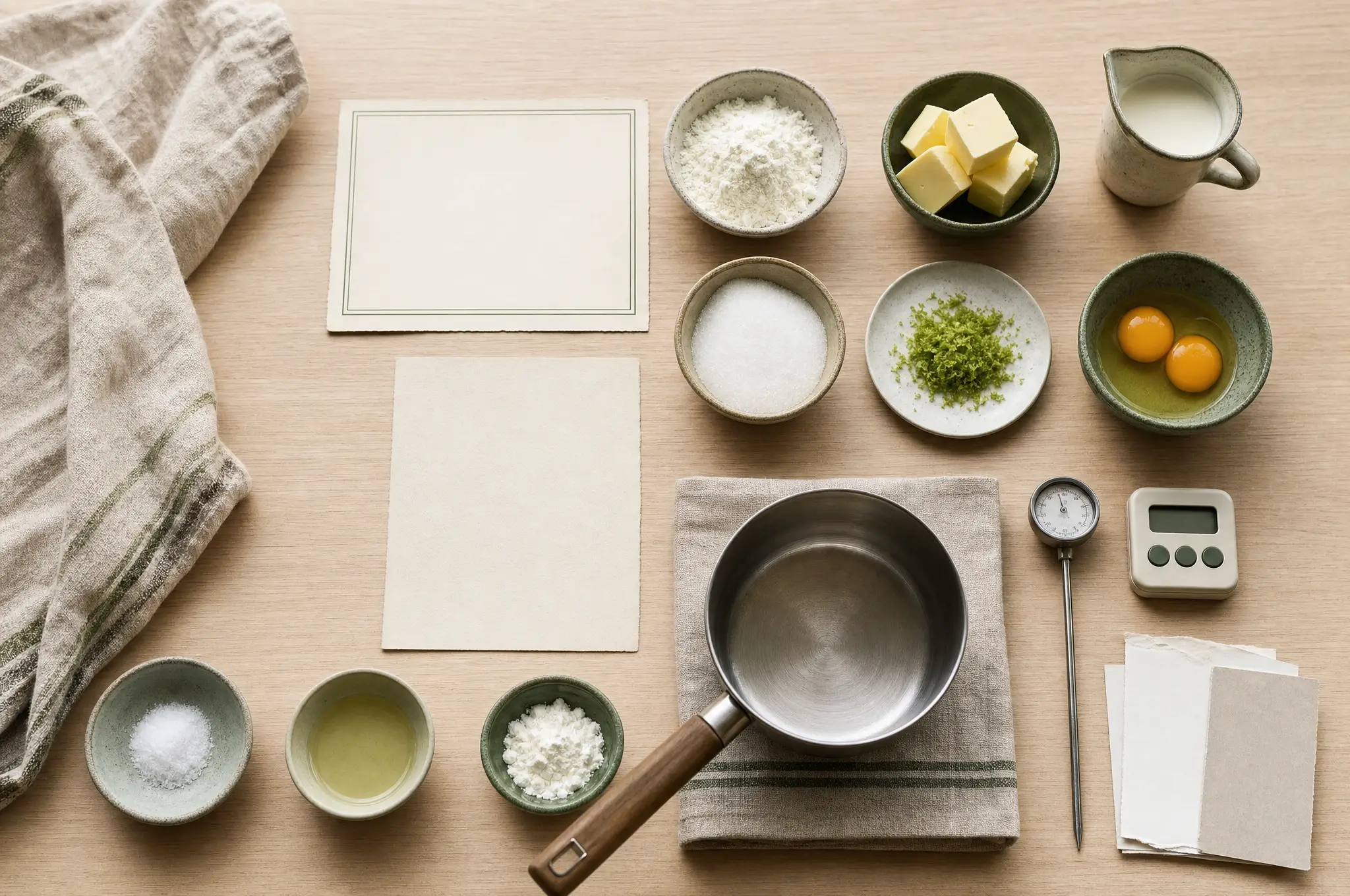
Before cooking, read the recipe from beginning to end and verify seven things: yield, ingredients, sequence, timing, equipment, source, and safety-critical instructions. Five minutes of review is cheaper than discovering halfway through that dough must chill overnight or an ingredient has no stated quantity.
The five-minute preflight
1. Confirm the yield
Know what the ingredient quantities are intended to make. If you change servings, decide whether pan size, cooking time, batch count, or seasoning also needs human judgment.
2. Reconcile ingredients and steps
Point to the step that uses each ingredient. Then scan the method for unnamed ingredients such as “add the remaining sauce.” Resolve divided quantities and preparation states: melted butter is not the same instruction as butter that melts in the pan.
3. Build the true timeline
Add preheating, thawing, marinating, resting, cooling, and parallel tasks. “30 minutes” may describe active cooking while excluding two hours of rest.
4. Check equipment assumptions
Pan material and dimensions, mixer or blender, thermometer, and oven type can change the result. Identify substitutions before you begin.
5. Find the source and version
Use the creator’s full recipe when possible. For an imported copy, open the retained source and compare quantities, units, order, and any later correction.
6. Mark judgment points
Good recipes often combine time with a physical cue: simmer until reduced, bake until the center reaches a described state. Note which cues matter so you do not follow a timer blindly.
7. Stop at safety-critical ambiguity
For raw meat, seafood, eggs, reheating, storage, canning, or allergy-sensitive cooking, use authoritative guidance and a complete tested recipe. The FDA’s safe food-handling guidance covers separation, cooking, chilling, and cleaning fundamentals. A recipe organizer—including Stow & Simmer—does not certify food safety or allergens.
A printable mental checklist
Yield fits?
All ingredients used?
All steps ordered?
Total timeline understood?
Equipment available?
Original source checked?
Safety-critical details complete?
If one answer is no, decide whether you can correct it from the source, add an explicit personal plan, or choose another recipe.
Review imported recipes as drafts
For an imported recipe, verify the saved result after import and before cooking. The dedicated import-review guide covers transfer errors; this checklist also applies to recipes typed by hand, inherited from family, or changed since the last cook.
Focus on consequential differences, not typography. A lost degree symbol matters more than whether “tbsp” became “tablespoon.”
Preflight does not mean rewriting everything
Leave a clear recipe alone when it fits your kitchen. The purpose is to identify hidden dependencies and risk, not optimize prose. Record only the decisions that would otherwise surprise you during cooking.
Try the workflow
Keep the source. Review the recipe. Cook from your version.
Download Stow & Simmer on the App StoreSources and further reading
- BBC Good Food — how to write a recipe
- FDA — safe food handling
- FDA — tips for writing food-safe recipes
Read how we research, draft, review, and correct guides in our editorial policy.