
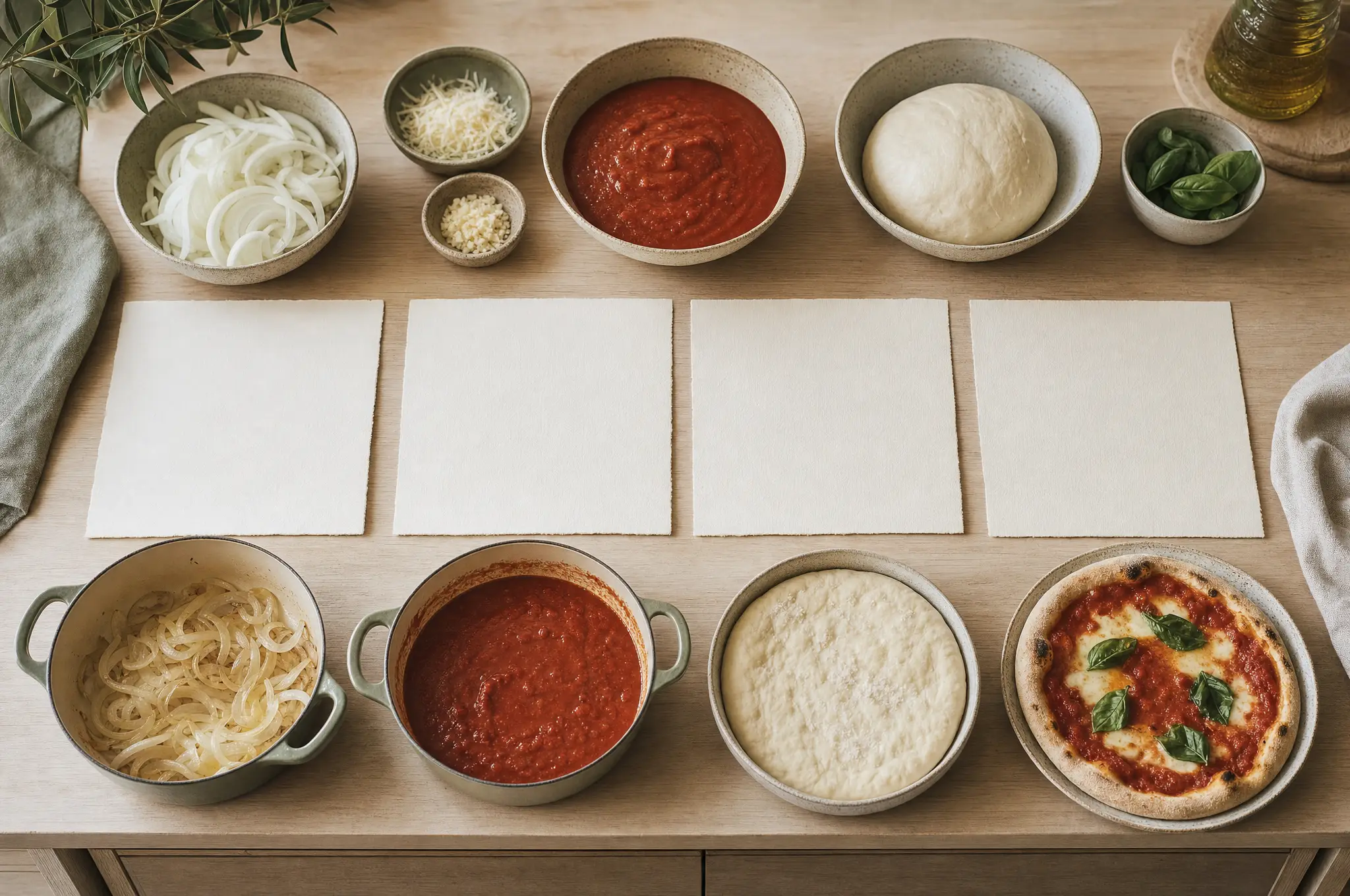
Keep a complete ingredient list for shopping and preparation, then repeat the relevant quantity beside the step that uses it. Name components consistently—“spice mixture,” “reserved pasta water,” “filling”—so the cook does not have to translate “it” or “the rest” under time pressure.
Preserve the master list
The ingredient list answers what to buy and prepare. Put ingredients in approximate order of use and include preparation states such as diced, softened, divided, or drained. BBC Good Food’s recipe-writing guidance likewise recommends listing ingredients in the order they are used.
Do not remove the list just because quantities also appear in steps. Duplication serves two different kitchen tasks.
Add contextual quantities to steps
Write:
Add 2 tablespoons of the olive oil to the pan.
rather than:
Add some of the oil.
Later, write the remaining amount explicitly if the source provides it. This is especially important after changing servings.
Group sub-recipes visibly
For a cake with sponge, filling, and glaze, group both ingredients and steps by component. Do not present three separate “sugar” lines without indicating which mixture receives each.
Use the same component name everywhere. A “dressing” in the list should not become “sauce” and then “mixture” in the method unless those are genuinely distinct.
Handle preparation at the right moment
“1 onion, diced” in the ingredient list may be enough for simple prep. If a technique depends on size or timing, explain it in the step: “dice into roughly 1 cm pieces so they soften evenly.” Do not invent dimensions absent from the source; add them only as your tested clarification.
Use a cooking view for focus, not source removal
Stow & Simmer Cook Mode presents ingredients and steps in a cooking-oriented flow and supports serving adjustment. Keep the source attached and review divided quantities after scaling. A clean display cannot correct an inconsistent recipe on its own. For comparison, AnyList documents its own ingredient-crossing and instruction-marking approach; these are interface choices, not proof that a source recipe is correct.
Check the links between lists
Before cooking, run two passes:
- For each ingredient, find the step that uses it.
- For each step, confirm that every named ingredient exists in the list.
Resolve or label mismatches. This small cross-check catches missing garnish, duplicated salt, and instructions that assume an unlisted sauce.
When repeating quantities becomes clutter
Repeat only what prevents a decision or navigation jump. A simple “stir in all prepared vegetables” may be clearer than listing six vegetables again when the grouping is unambiguous. Clarity, not maximal duplication, is the goal.
Try the workflow
Keep the source. Review the recipe. Cook from your version.
Download Stow & Simmer on the App StoreSources and further reading
Read how we research, draft, review, and correct guides in our editorial policy.